

News
January 16, 2026
Reconstructing the 1911 Exhibition: an internship between HBIM and 3D printing
By Erica Casareto
The Turin 1911 project is not only a research initiative aimed at the digital enhancement of the architecture of the International Exhibition, but also a training context in which students can undertake internships, actively contributing to the reconstruction and dissemination of a heritage that has now disappeared. Through activities combining historical research, 3D modelling, and technological experimentation, internships offer the opportunity to engage with advanced methods and tools applied to cultural heritage.
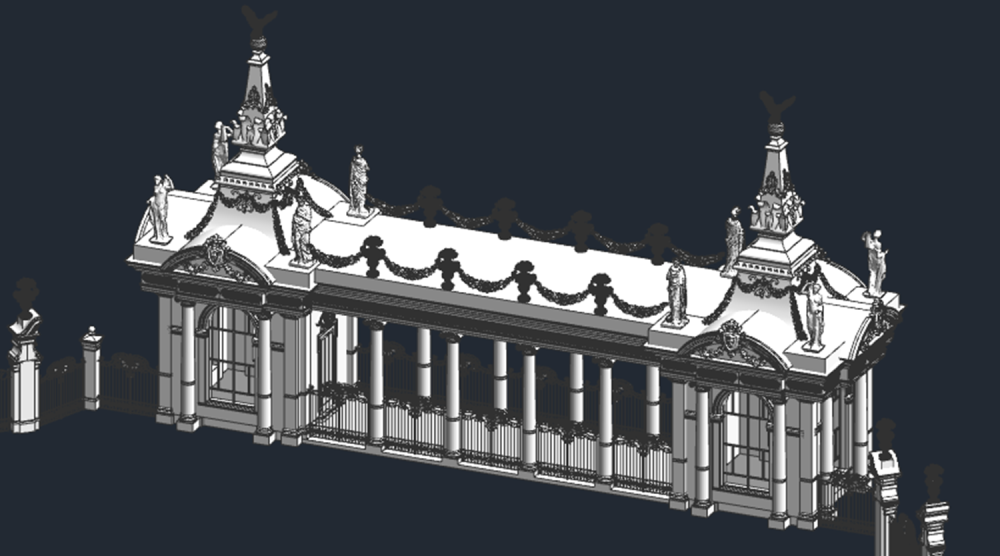
One of these internship paths, carried out by Mahtab Khoddami, focused on two main areas. The first concerned the digital reconstruction of the monumental entrance, located between Corso Vittorio Emanuele II and Corso Cairoli.
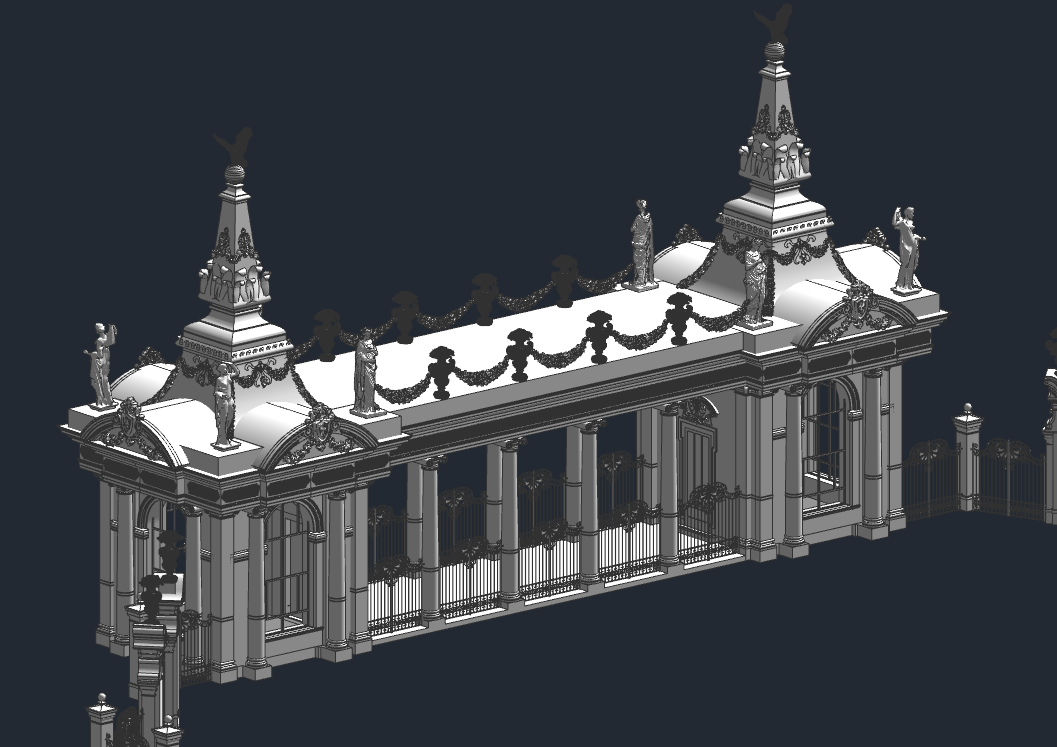
The intervention involved the creation of an HBIM (Heritage Building Information Modeling) model developed entirely from historical documentation, since the original architecture no longer exists. The absence of direct surveys required careful analysis and comparison of heterogeneous sources, including historical plans, photographs, and postcards, which were used to reconstruct proportions, decorative systems, and hypothesised materials.
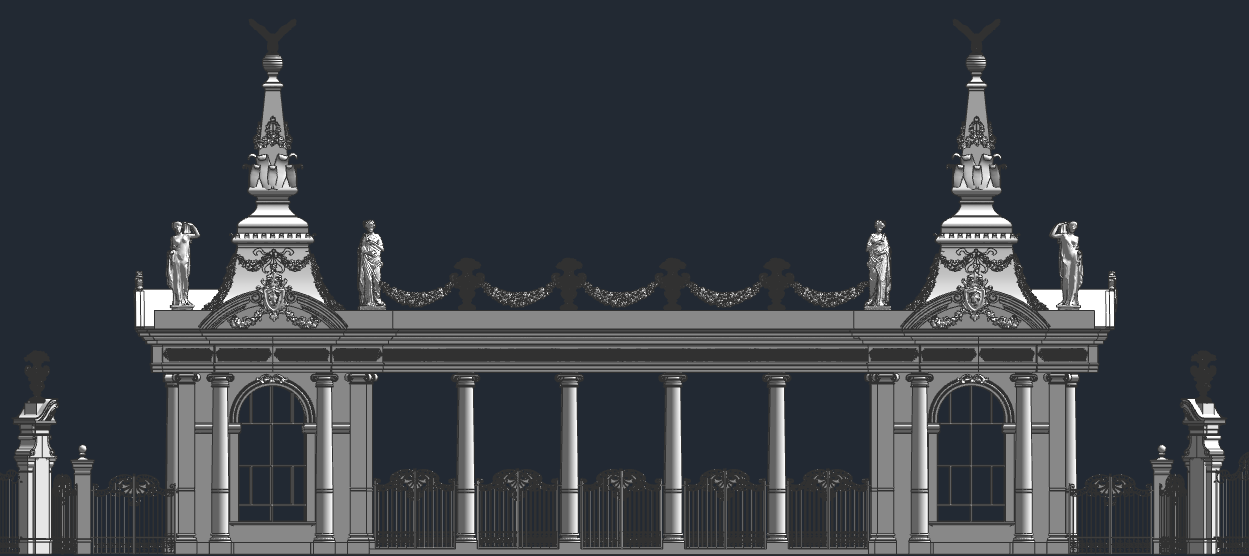
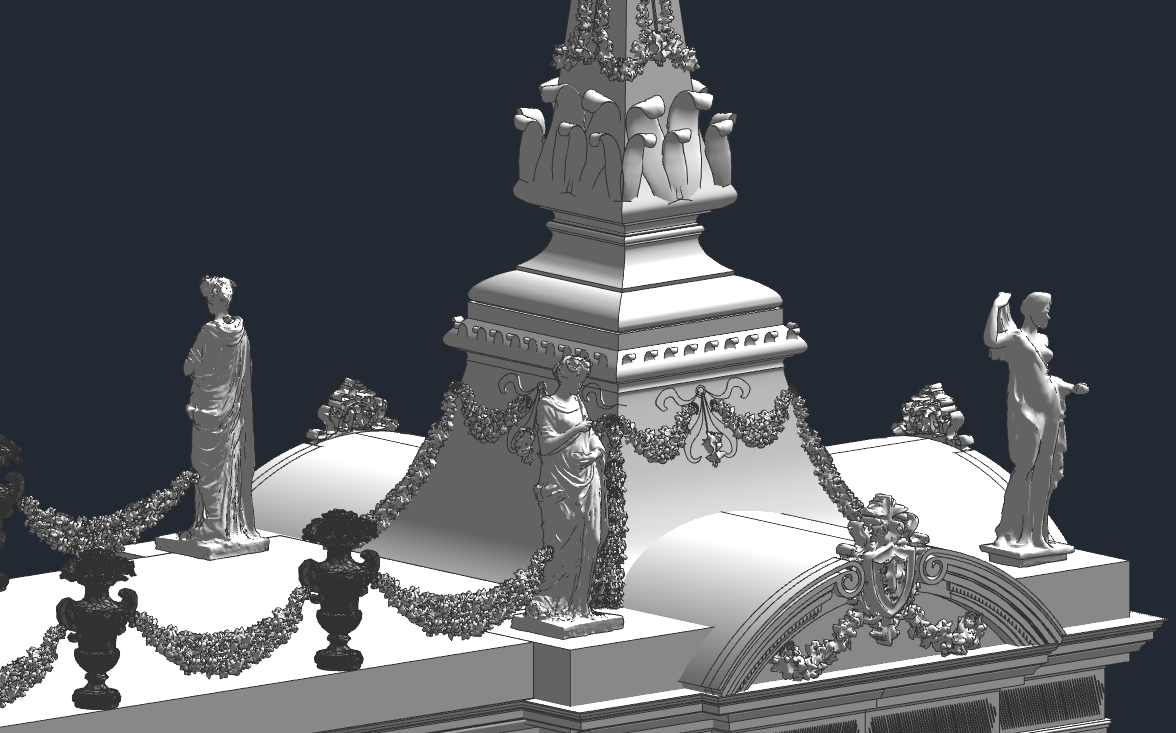
Modelling was approached as a critical and interpretative process: each architectural element of the entrance was reconstructed in a BIM environment using parametric families, while the more complex and sculptural components were developed using artificial intelligence tools and subsequently refined to ensure formal coherence and metric accuracy. The result is a detailed three-dimensional model capable of conveying not only the monumental appearance of the entrance, but also its symbolic and urban role within the 1911 Exhibition.
The second area of the internship focused on the refinement of the already existing digital model of the Siam Pavilion, aimed at scaled 3D printing. The model was reworked several times to adapt it to the requirements of prototyping, with a progressive simplification or redefinition of details according to the different printing scales. Two three-dimensional prints were produced: one at a 1:600 scale, intended to place the pavilion in dimensional relation to the existing model of the Hungary Pavilion, and one at a 1:250 scale, which allowed for a more accurate representation of architectural elements.
.png)
In the case of the 1:600 scale, the pavilion was divided into main parts, printed separately and subsequently assembled, with the aim of obtaining an openable model that would allow observation of the internal structure and columns, with particular attention to the central roof. At the 1:600 scale, instead, the necessary reduction in the level of detail led to the creation of a single unified volume, more suitable for an overall reading of proportions.
The models were printed in collaboration with the MODLab Arch. laboratory of the Politecnico di Torino.
.png)